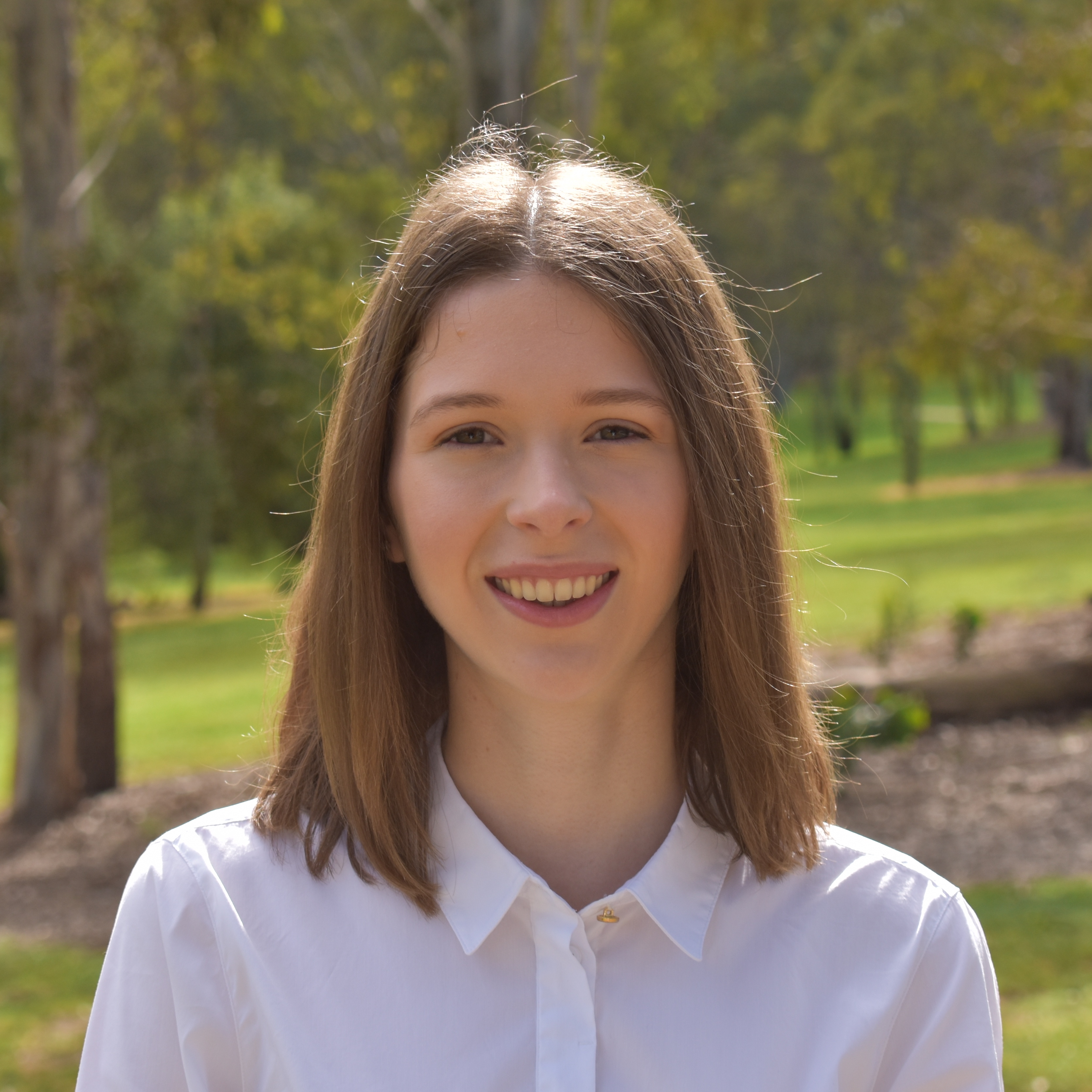
Bridget is a Rhodes Scholar and DPhil candidate in Mathematics at the University of Oxford, supervised by Professor Renaud Lambiotte and Professor J. Doyne Farmer. She is affiliated with the Mathematical Institute and the Institute for New Economic Thinking at the Oxford Martin School.

Her work is motivated by the social dynamics that emerge from interactions between people, technologies, institutions, and their environments. These range from how information spreads and shapes beliefs on social media to how individual decisions produce collective outcomes in prediction markets. She develops mathematical methods for understanding the mechanisms behind these complex dynamics, with the goal of building models that are both mathematically meaningful and useful in practice.

Bridget Smart

Research

A path through a network, with arrows showing a sequence of steps from node to node.

Untangling memory and influence in complex systems

Predicting sequences of movements, interactions or events means accounting for both memory (how the past shapes what happens next) and structure (who or what can interact). Higher-order Markov modelscapture memory, but their state space grows exponentially and they quickly become hard to interpret. This project develops the Separable Markov model, a compact and interpretable alternative for settings with long-range memory and limited data.
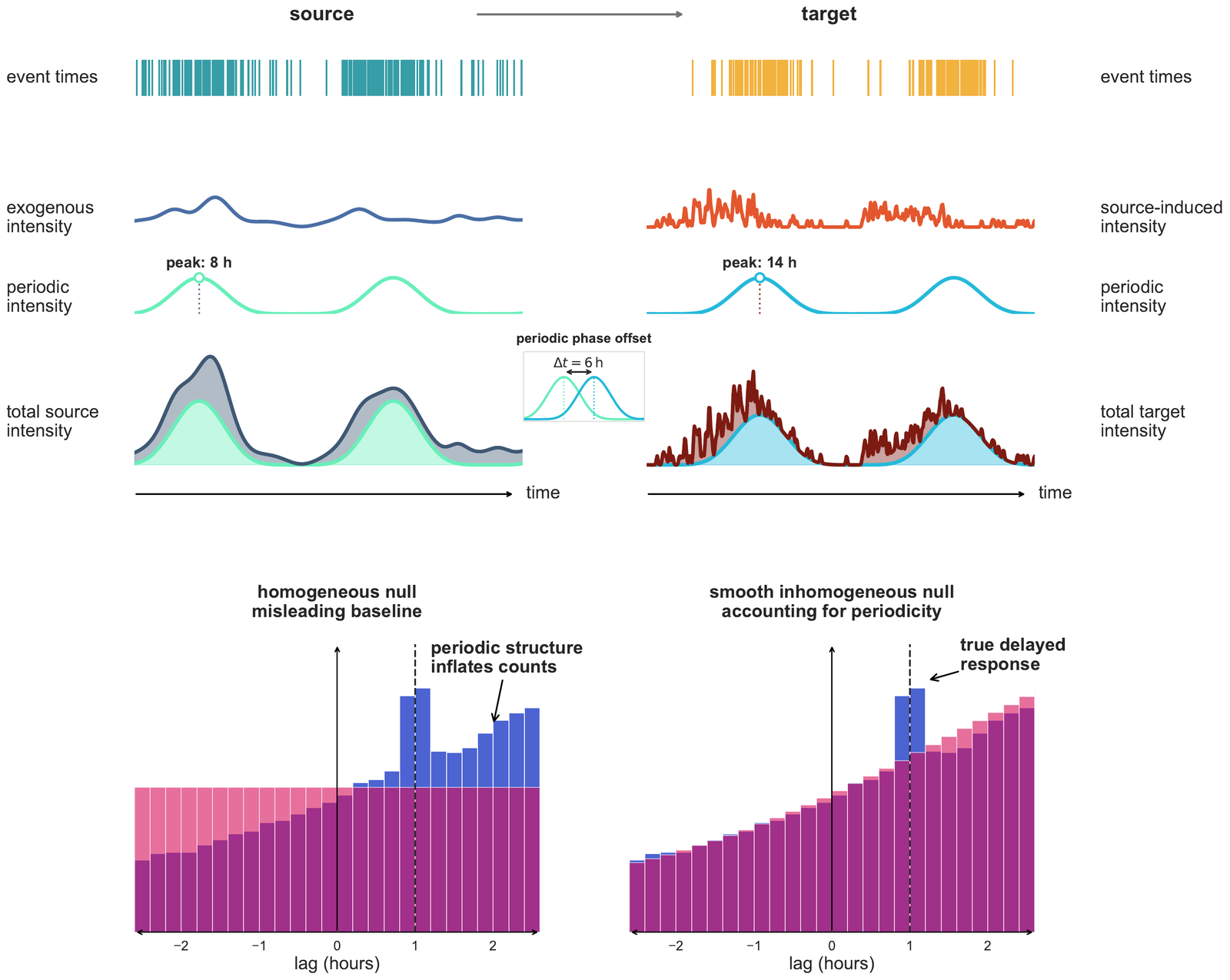
Simulated source and target event streams with daily cycles. A naive null model mistakes periodic structure for interaction, while a null model that accounts for periodicity isolates the true one-hour delayed response.

Inferring temporal dependencies from social time series

Human interactions are bursty and follow daily rhythms. This makes it extremely difficult to tell whether one event tends to trigger another, or whether they simply happen at similar times. This work adapts the cross-correlogram, a method from neuroscience, to distinguish lagged dependencies from correlations driven by bursty or rhythmic activity. Applied to 3.1 million posts on X, our method recovers known television broadcast schedules.

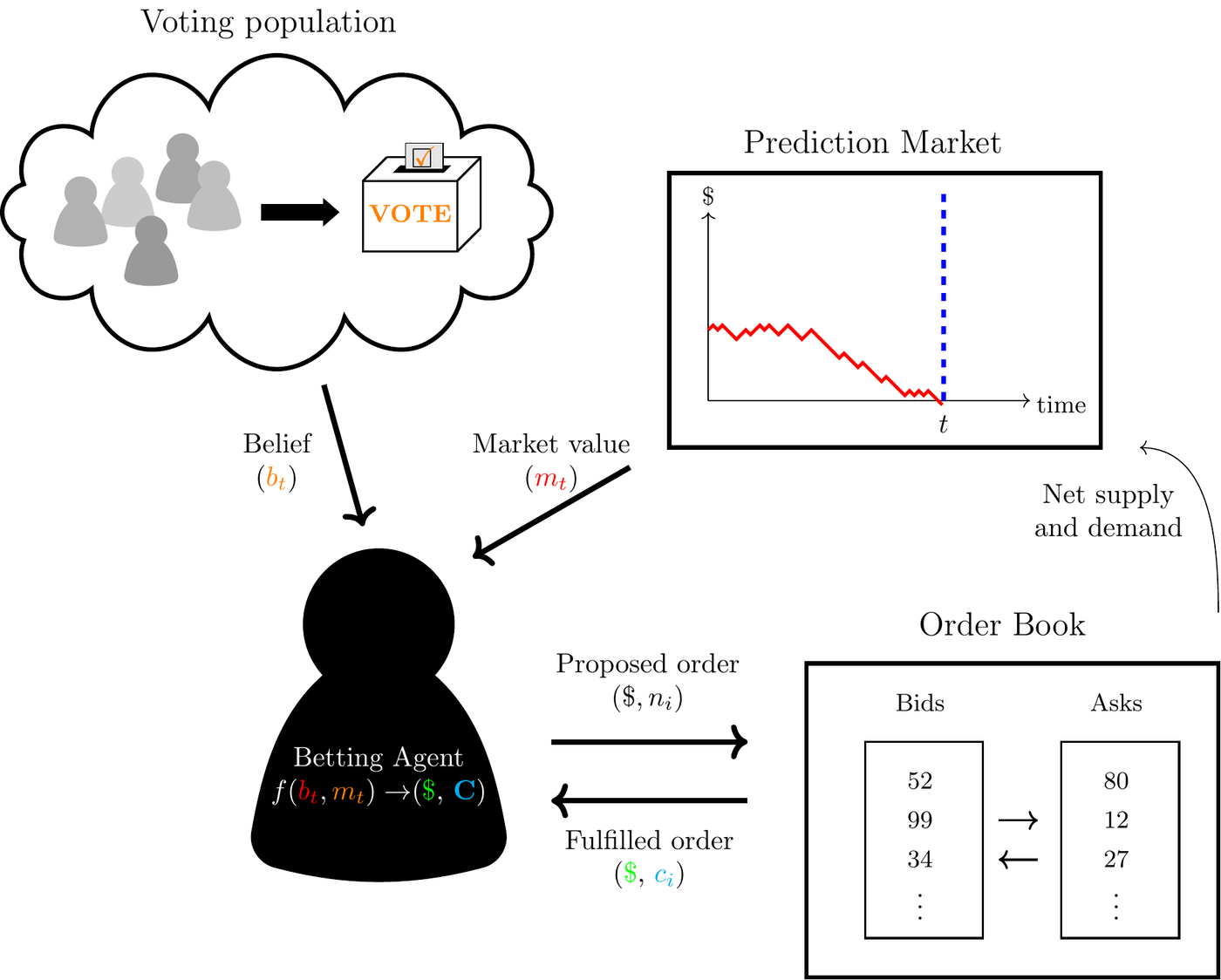
Diagram of the agent-based model: betting agents form beliefs from a voting population and the market price, and trade through an order book that sets the prediction-market price.

Manipulation in prediction markets

Prediction markets are sometimes interpreted as predictions of how likely a future event is to occur. Using a simple model of a prediction market, this work shows that a single trader with sufficient capital can manipulate prices. The key result is that biased traders can temporarily shift market prices, with the magnitude and duration of this distortion increasing if other traders herd toward the market price or are slow to update their internal valuations.

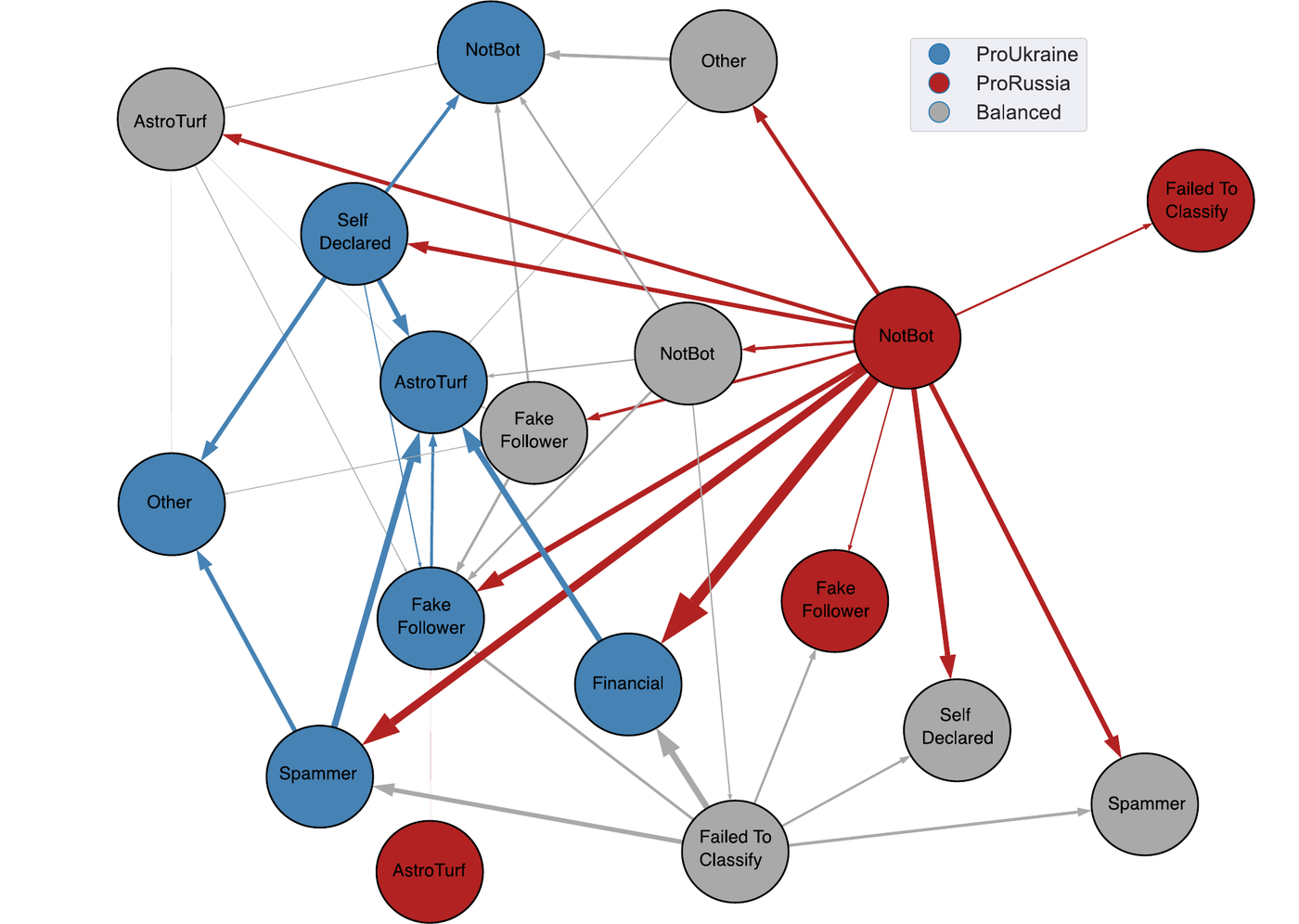
Network of information flow between pro-Ukraine, pro-Russia and balanced account types, including bots and non-bots. Arrow width shows the strength of flow.

Bots, humans and information flow online

In the first weeks of the 2022 Russian invasion of Ukraine, we used information-theoretic estimators, network science and natural language processing methods to measure influence between bot and human accounts on Twitter.

Recent highlights

Beyond research

Before Oxford, Bridget completed an MPhil in Applied Mathematics and Statistics at the University of Adelaide as a Westpac Future Leaders Scholar. Her thesis on measuring and modelling information flows in real-world networks received the Dean’s Commendation for Thesis Excellence.

She enjoys teaching probability, statistics, graph theory and information theory at Oxford and is a Non-Stipendiary Lecturer at New College. Bridget is committed to creating a diverse, welcoming and engaged STEM community.

She enjoys sharing research beyond academia. She contributed to the Youth National Security Strategy and has spoken about mis- and disinformation on this podcast.